3V0-24.25 Simulations Pdf & 3V0-24.25 Exam Simulations
Wiki Article
BTW, DOWNLOAD part of Exam-Killer 3V0-24.25 dumps from Cloud Storage: https://drive.google.com/open?id=1nsDH279xdhRlU2ouUXktchoi8c3bLRim
You do not need to think it is too late for you to study. As the saying goes, success and opportunity are only given to those people who are well-prepared! If you really long to own the 3V0-24.25 certification, it is necessary for you to act now. We are willing to help you gain the certification. In order to meet the needs of all people, the experts of our company designed such a 3V0-24.25 Guide Torrent that can help you pass your exam successfully.
VMware 3V0-24.25 Exam Syllabus Topics:
| Topic | Details |
|---|---|
| Topic 1 |
|
| Topic 2 |
|
| Topic 3 |
|
| Topic 4 |
|
| Topic 5 |
|
>> 3V0-24.25 Simulations Pdf <<
Absolute Your Exam Preparation With VMware 3V0-24.25 Dumps
You know, your time is very precious in this fast-paced society. If you only rely on one person's strength, it is difficult for you to gain an advantage. Our 3V0-24.25 learning questions will be your most satisfied assistant. On one hand, our 3V0-24.25 exam copyright contain the most important keypoints about the subject which are collected by our professional experts who have been devoting in this career for years. On the other hand, we always keep updating our 3V0-24.25 Study Guide to the latest.
VMware Advanced VMware Cloud Foundation 9.0 vSphere Kubernetes Service Sample Questions (Q22-Q27):
NEW QUESTION # 22
A Security Operations Analyst is designing a Role-Based Access Control (RBAC) strategy for the finance namespace. The strategy must enforce the principle of least privilege.
Requirements:
1. Auditors: Read-only access to all resources.
2. Developers: Ability to create Deployments, Services, and ConfigMaps, but cannot delete Persistent Volumes or modify Resource Quotas.
3. Admins: Full control.
Review the available default ClusterRoles in vSphere with Tanzu:
* view
* edit
* admin
* cluster-admin
Which mapping of Groups to Roles correctly satisfies these requirements? (Select all that apply.)
- A. Map the Developers group to the edit ClusterRole.
- B. Map the Developers group to a custom Role dev-limited because the default edit role allows deleting Persistent Volume Claims (PVCs) which triggers PV deletion, and potentially allows resource consumption beyond intent if Quotas aren't strictly locked by the admin role.
- C. Map the Admins group to the admin ClusterRole (within the namespace).
- D. Map the Auditors group to cluster-admin to ensure they can see everything.
- E. Map the Auditors group to the view ClusterRole.
Answer: A,C,E
NEW QUESTION # 23
In a vSphere with Tanzu environment, which component is responsible for automatically adjusting the number of worker nodes in a Tanzu Kubernetes Grid (TKG) cluster based on the pending pod requests?
- A. The Distributed Resource Scheduler (DRS) running on the vCenter Server.
- B. The Cluster Autoscaler (integrated as part of the Cluster API provider logic) which monitors for unschedulable pods and interfaces with the Supervisor to provision new Machine objects.
- C. The Horizontal Pod Autoscaler (HPA) running inside the TKG cluster.
- D. The vSphere HA agent running on the ESXi hosts.
Answer: B
NEW QUESTION # 24
An administrator had deployed a Supervisor cluster on vSphere in a mult?-zone-enabled environment and now wants to create a zonal vSphere Namespace so that workloads can be scheduled across zones.
Drag and drop the six actions into the correct order from Configuration Option list on the left and place them Into the Configuration Sequence on the right.
(Choose six.)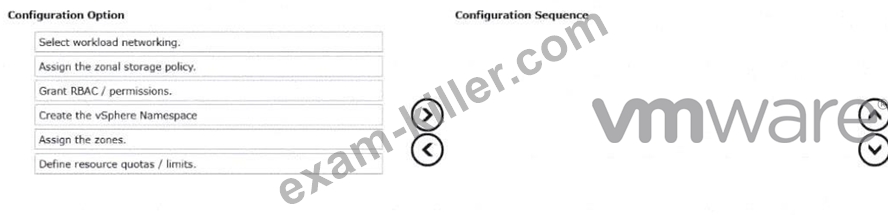
Answer:
Explanation: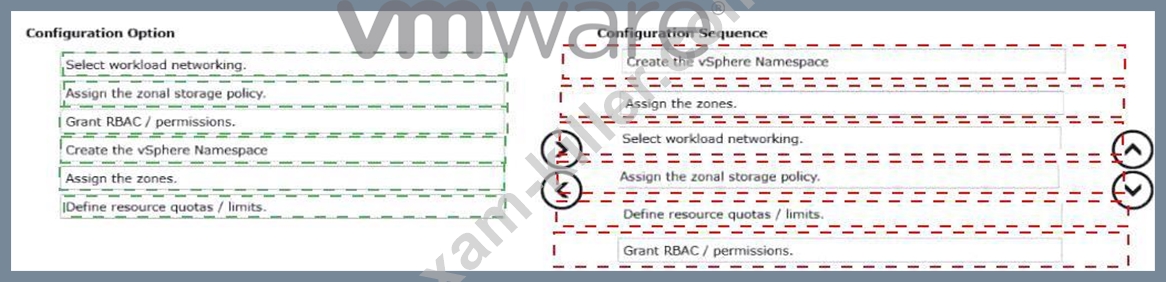
Explanation:
Configuration Sequence (in order):
* Create the vSphere Namespace
* Assign the zones
* Select workload networking
* Assign the zonal storage policy
* Define resource quotas / limits
* Grant RBAC / permissions
A zonal vSphere Namespace is created as a standard namespace first, then "zonalized" by associating it with one or morevSphere Zonesso workloads can be scheduled according to zone placement rules. You start bycreating the namespacebecause it is the tenancy and governance container where networking, storage access, quotas, and permissions are applied. Next, youassign the zones, since zone association is what makes the namespace "zonal" and determines where Kubernetes workloads (and their node pools) are allowed to land.
With zones set, you configureworkload networking, because namespaces must have the correct network attachment and IP behavior for the workloads that will be placed across the selected zones. Then youassign the zonal storage policy, ensuring that persistent volumes can be provisioned using storage that is valid
/available for the zone placement model you selected. After networking and storage access are defined, you setresource quotas/limits(CPU, memory, storage) so multi-tenant consumption stays within governance boundaries. Finally, yougrant RBAC/permissionsso the right DevOps/users can consume the namespace and provision clusters/workloads under the enforced controls.
NEW QUESTION # 25
The DevOps Engineer was tasked to deploy a new application on a local cluster. When the application was deployed in the Namespace, it was decided that a newer version of Kubernetes was required. The DevOps Engineer requested the vSphere Admin to upgrade their Kubernetes version. The vSphere Admin checked compatibility between the Supervisor and all running VKS clusters, and then successfully upgraded vSphere Supervisor to the latest version. The DevOps Engineer could not get the application to work. What caused the application to fail?
- A. The vSphere Admin did everything correctly and the DevOps Engineer is deploying the application wrong.
- B. The vSphere Admin failed to complete all the pre-checks before the upgrade.
- C. The vSphere Admin upgraded the Supervisor Control Plane.
- D. The vSphere Admin pulled down the wrong version of the Supervisor.
Answer: C
Explanation:
The failure in this scenario stems from a misunderstanding of the decoupled lifecycle architecture within VMware Cloud Foundation (VCF) 9.0. In a vSphere Kubernetes Service (VKS) environment, the vSphere Supervisor (the management plane) and the Tanzu Kubernetes clusters (the workload plane) are upgraded independently. When the administrator upgraded the vSphere Supervisor to the latest version, they effectively updated the control plane that manages the SDDC resources and Kubernetes APIs, but this action did not automatically upgrade the Kubernetes version of the individual VKS workload clusters where the application was running.
Because the DevOps engineer ' s application required a specific, newer version of Kubernetes, the application remained incompatible because the workload cluster ' s distribution version remained unchanged. To resolve this, after the Supervisor is upgraded, the administrator must explicitly trigger an upgrade of the VKS cluster by updating the tkr.tanzu.vmware.com (Tanzu Kubernetes Release) version in the cluster ' s YAML specification. This triggers the Cluster API (CAPI) controllers to perform a rolling update of the worker and control plane nodes. In VCF 9.0, this separation is a feature designed to prevent global downtime; however, it requires administrators to perform a two-step process: first, the Supervisor Control Plane upgrade (Option D), followed by the individual workload cluster upgrades. Without the second step, the Kubernetes environment seen by the application remains at the legacy version.
NEW QUESTION # 26
A Cloud Administrator is evaluating the use of Custom Ingress Controllers (e.g., Contour, Nginx) versus the Native NSX Load Balancer for handling Layer 7 traffic in a vSphere with Tanzu environment.
The goal is to support advanced traffic shaping, such as header-based routing and TLS termination at the ingress layer, while minimizing the consumption of Load Balancer VIPs (Virtual IPs) from the limited pool.
Why would deploying a Custom Ingress Controller (like Contour) via a TKG Extension be architecturally preferable to using type: LoadBalancer for every service? (Select all that apply.)
- A. A Custom Ingress Controller consumes only one Load Balancer VIP (L4) to expose itself, and then routes traffic to multiple internal services based on Host/Path rules (L7), significantly conserving VIPs.
- B. The Native NSX Load Balancer (in the context of type: LoadBalancer) primarily operates at Layer 4 (TCP/UDP); advanced L7 features often require an Ingress Controller layer on top.
- C. Custom Ingress Controllers run as Pods inside the cluster, allowing developers to define routing rules via Ingress or HTTPProxy resources without requiring vSphere Administrator intervention for every rule change.
- D. Using a Custom Ingress Controller removes the need for NSX entirely.
- E. Custom Ingress Controllers automatically bypass the SNAT rules of the namespace.
Answer: A,B,C
NEW QUESTION # 27
......
The free demo 3V0-24.25 practice question is available for instant download. Download the VMware 3V0-24.25 exam dumps demo free of cost and explores the top features of VMware 3V0-24.25 Exam Questions and if you feel that the Advanced VMware Cloud Foundation 9.0 vSphere Kubernetes Service exam questions can be helpful in 3V0-24.25 exam preparation then take your buying decision.
3V0-24.25 Exam Simulations: https://www.exam-killer.com/3V0-24.25-valid-questions.html
- 3V0-24.25 Actual Test Answers ???? 3V0-24.25 Latest Dumps Pdf ???? 3V0-24.25 Exam Simulator ➖ The page for free download of [ 3V0-24.25 ] on ➽ www.easy4engine.com ???? will open immediately ????Valid 3V0-24.25 Exam Tutorial
- Free PDF Quiz VMware - 3V0-24.25 - Latest Advanced VMware Cloud Foundation 9.0 vSphere Kubernetes Service Simulations Pdf ???? Open website ( www.pdfvce.com ) and search for ( 3V0-24.25 ) for free download ????Valid 3V0-24.25 Test Cram
- Valid 3V0-24.25 Test Cram ???? 3V0-24.25 Pass4sure Exam Prep ???? 3V0-24.25 Exam Flashcards ???? Search for ✔ 3V0-24.25 ️✔️ on { www.pdfdumps.com } immediately to obtain a free download ????Valid 3V0-24.25 Test Cram
- Top 3V0-24.25 Simulations Pdf bring you Unparalleled 3V0-24.25 Exam Simulations for VMware Advanced VMware Cloud Foundation 9.0 vSphere Kubernetes Service ???? Open ( www.pdfvce.com ) enter ➤ 3V0-24.25 ⮘ and obtain a free download ????Fresh 3V0-24.25 Dumps
- Pass Guaranteed Quiz Useful 3V0-24.25 - Advanced VMware Cloud Foundation 9.0 vSphere Kubernetes Service Simulations Pdf ???? Search for ⏩ 3V0-24.25 ⏪ on ➥ www.prepawaypdf.com ???? immediately to obtain a free download ➡Fresh 3V0-24.25 Dumps
- 100% Pass-Rate VMware 3V0-24.25 Simulations Pdf - Perfect Pdfvce - Leader in Certification Exam Materials ???? Open website ⏩ www.pdfvce.com ⏪ and search for ⮆ 3V0-24.25 ⮄ for free download ????3V0-24.25 Exam Simulator
- Latest 3V0-24.25 Dumps Pdf ???? 3V0-24.25 Test Questions ???? 3V0-24.25 Exam Flashcards ???? Immediately open ▷ www.vce4dumps.com ◁ and search for “ 3V0-24.25 ” to obtain a free download ????3V0-24.25 Test Questions
- 3V0-24.25 Latest Dumps Pdf ???? 3V0-24.25 Test Questions ☘ Valid Exam 3V0-24.25 Blueprint ↔ Search for ➡ 3V0-24.25 ️⬅️ and obtain a free download on ▛ www.pdfvce.com ▟ ????Latest 3V0-24.25 Dumps Pdf
- Reliable 3V0-24.25 Exam Topics ???? Latest 3V0-24.25 Dumps Pdf ???? 3V0-24.25 Exam Flashcards ???? Search for ⇛ 3V0-24.25 ⇚ and download it for free immediately on 《 www.examcollectionpass.com 》 ????3V0-24.25 Exam Simulator
- Reliable 3V0-24.25 Exam Topics ???? 3V0-24.25 Practice Test Engine ???? 3V0-24.25 Actual Test Answers ???? Search for ⮆ 3V0-24.25 ⮄ and download exam materials for free through { www.pdfvce.com } ▶3V0-24.25 Test Questions
- 3V0-24.25 Exam Torrent ???? 3V0-24.25 Technical Training ???? 3V0-24.25 Latest Dumps Pdf ☸ Easily obtain free download of ▶ 3V0-24.25 ◀ by searching on ➽ www.examcollectionpass.com ???? ????3V0-24.25 Exam Torrent
- izaakrdco286862.blog2news.com, socialicus.com, lancejxzx691490.azuria-wiki.com, ammarmbzo660113.blogthisbiz.com, cyberbookmarking.com, phoebefxvf846821.ambien-blog.com, marvinodgi413332.evawiki.com, zoyaslfm969068.glifeblog.com, nicolefjhv187864.wikinarration.com, myportal.utt.edu.tt, myportal.utt.edu.tt, myportal.utt.edu.tt, myportal.utt.edu.tt, myportal.utt.edu.tt, myportal.utt.edu.tt, myportal.utt.edu.tt, myportal.utt.edu.tt, myportal.utt.edu.tt, myportal.utt.edu.tt, Disposable vapes
BTW, DOWNLOAD part of Exam-Killer 3V0-24.25 dumps from Cloud Storage: https://drive.google.com/open?id=1nsDH279xdhRlU2ouUXktchoi8c3bLRim
Report this wiki page